



An HVAC technician checking an outdoor air-conditioning unit beside a house

Industry

Field Services

Who this is forFor plumbing, HVAC, electrical, landscaping and cleaning companies, and the people who hire them.

The problems

What gets in the way

Water across a tiled floor at home, slippers and a bucket left standing in it
Customers can't find a trustworthy local pro — or the parts to DIY
A tradesman on the phone in the cab of his work van
Pros pay for junk leads and run on five disconnected tools
Paper receipts and invoices scattered across a desk
No single view of jobs, customers, or revenue

How we fix it

  • AI matching from a plain-language job to vetted local pros — or an AI DIY guide
  • Parts & materials matched to the job, with quantities, costs, and buy links
  • An operator OS: quotes, jobs, crews, invoicing, payments, and a customer portal
The processes we rebuild most often in field services →
  1. Intake and quoting

    Every request, from call, form or text, becomes a structured job with the details a quote needs. Quotes come from a maintained price book, go out in minutes, and get followed up automatically until they are accepted or declined.

  2. Scheduling and dispatch

    Jobs land on the crew with the right skills and the shortest drive, with the day re-planned when a job runs long or a customer cancels, instead of a dispatcher redrawing the whiteboard.

  3. Field data capture

    Techs log time, materials, photos and signatures from the phone, so the invoice is complete when the truck door closes and the office is not chasing paper on Friday.

  4. Job costing and margin

    Every job shows what it was quoted at, what it cost in labour and materials, and what it earned, so you learn which work and which customers are actually profitable.

zerofi.ai
ZeroFi — the live site
ZeroFi, designed, built and run by Nirvana. How we built it →
Read the full write-up →

How a field-service business runs the day, and what it costs

A plumbing, HVAC, electrical, landscaping or cleaning company sells the same thing every day: a person with skills, at an address, at a time. Everything around that is coordination, and most of it still runs on a phone, a whiteboard and a dispatcher's memory. A job comes in by call or form, gets written down, gets a quote assembled from last time's numbers, gets scheduled around who is nearest, and gets invoiced days later from a photo of a paper ticket.

The cost is not any one of those steps. It is the gaps between them: the callback that never happened, the quote that was never followed up, the crew that drove across town because the schedule was built by hand, the invoice that went out a week late because the tech forgot to note the extra materials. Owners feel it as revenue that should have been there.

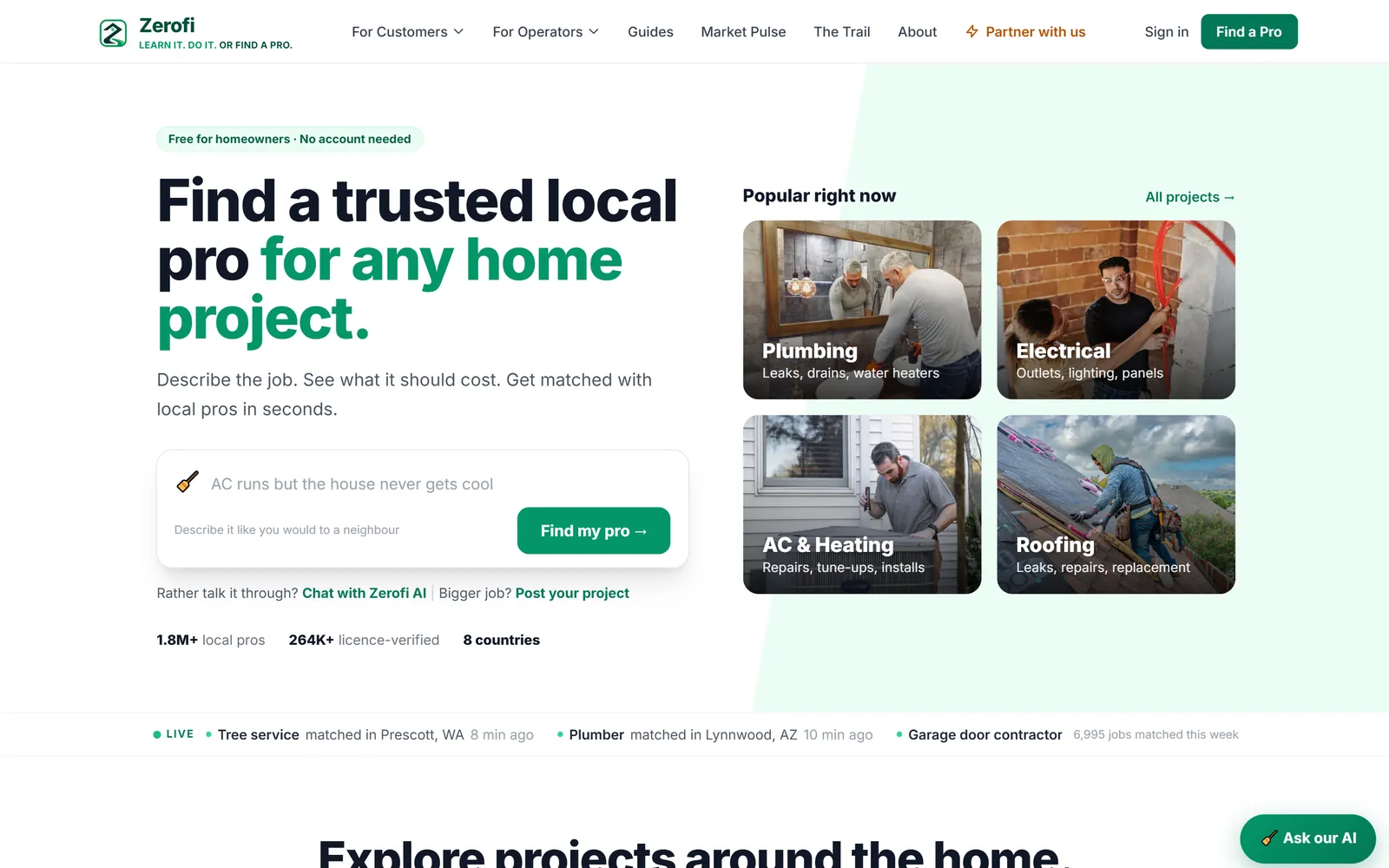
ZeroFi, the marketplace we designed, built and run, answers it from the demand side: a homeowner or business describes the job in plain language, AI matches it to a vetted local pro, and the pro gets the lead free. Behind it is an operator platform the pro runs the whole business on: quotes, jobs, crews, invoicing, payments and a customer portal. It exists because we could not find software that treated the pro's back office and the customer's front door as the same system.

For an established company with its own customer base, the same pieces get built to fit: intake that captures the job properly the first time, scheduling that respects skills and geography, quoting from a real price book, and field data capture that turns a finished job into an invoice the same afternoon.

ZeroFi, AI Field-Service Marketplace: The AI field-service marketplace. Describe a job and get matched to a vetted local pro — or an AI DIY guide with the exact tools, parts, and real costs. Pros get free leads and run the whole business on one platform.


What we rebuild here

All 31 →

Questions we get

We already use a field-service app. Why rebuild anything?+

Most companies run three or four tools that do not share data, plus spreadsheets in the gaps. We usually keep the tool that works, connect to it, and build the missing piece: the quoting engine, the customer portal, the margin view. Replacing everything is rarely the first move.

Can our technicians actually use it in the field?+

It is built for a phone with one hand and a bad signal: large targets, offline capture that syncs later, photos and signatures, no typing where a tap will do. If your techs will not use it, it does not count as built.

How does this connect to QuickBooks or our accounting?+

Invoices, payments and customer records sync to your accounting system rather than being re-entered. Which system depends on you; the pattern is the same.

What is the first thing you would build for a field-service company?+

Almost always intake plus quoting, because that is where revenue leaks and it is the fastest to prove. A working version takes about five days after scoping, and you own the code.

Let's build

What's your AI Nirvana?

Tell us where you want to go. We'll bring the team, build the product, and grow it with you — and you own it.

  • You own the IP
  • US-based team
  • Reply within 1 business day